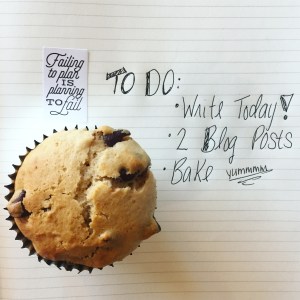
how do you make your writing goals stick?

img_0009Making writing goals and plans can sometimes be a challenge, but it’s even a bigger challenge to follow through with them.

As writers, we are challenged with having two parts of our lives– the writing part, and the other part. The balance can be a nightmare sometimes, and other times we wonder why others complain about not having the time to do what they love.

It’s understandable. That’s life, after all.

But what happens during those times that feel like we’ve stepped into a horror film? Those times that the plans you wrote down for the day (or the week, or the month) slip away and we find ourselves wordless and feeling lousy?

MAKE SACRIFICES

Oftentimes we don’t write because we feel like something else is more important, or it’s just distracting us. If that pile of laundry in the corner is laughing at you as you try to hash out a scene, tell it to shut-up and keep going.

It’s OK to let the laundry sit for a day so you can write, or the dishes, or the dusting– or whatever it is.

If it’s not house work, and you think your distraction is far more important– it’s up to you to decide what to sacrifice so you can get your writing time in.

PLAN AHEAD

Not good at making sacrifices? Plan ahead. Get that project done before the due date so you have time to enjoy your own writing. Make some freezer meals (or even order a pizza) to have the troops fed so you can snuggle in without interruptions (maybe). Know when you’re writing time is and make sure to prep for it.

You might never have all your bases covered, but you can come as close as possible with a little planning.

TAKE IT ONE WORD AT A TIME

Goals can be scary. And if they’re not scary, that usually means they’re not “big enough”… or so I’ve been told. The thing is, you don’t want to make your goals so outrageous that you feel overwhelmed just thinking about them.

Take your goals one word at a time. If your goal is to write 5k words in one week and you only make 3k, that’s OK! Pick up the slack the next week, or by the end of the month. The great thing about it all is you are your worst critic.

Don’t want to miss out on those 2k words? Enlist a Critique Partner or Writing Buddy that will keep you accountable. Just remember that sometimes the words come slower at times of stress and busy-ness than they do when the other part of your world is all rainbows and unicorns.

It’s so important to make our writing a priority and meeting those goals. Not only for ourselves, but for our future readers as well. But it’s never going to be easy (unless you’re a full time writer, and even then that’s debatable), and it’s always going to take work. What makes you different is you’re already halfway there– because you’ve started, you’re making the time!

You’re not just saying, I want to write a book

you’re actually doing it.

new year, new writing

img_2251It’s hard to believe we are ten days into the new year already. With a new year always comes new expectations, and as a writer it’s hard not to set that bar high with goals and aspirations for the next twelve months.

After all, it’s a new year- with no mistakes in it.

Yet.

Maybe you want to make up for what you didn’t do last year. Maybe you want to be more consistent with your blog, your marketing, your WIP, your planning, your pantsing– maybe all of the above. Whatever the case, remember to give yourself some breathing room. Just because it’s a new year does not mean everything is going to change over night.

After Christmas and before New Year’s Eve, I sat down and planned out my blogging for the next three months. I have high hopes for sticking to it, and doing the same thing in March before my plans are up.

I know I can do it. The question is will I make the time to do it.

With the blogging I planned out my timelines for my current projects. One by Valentine’s Day, the other by June. Both projects need editing and, well, one needs to be completely finished. Once again, I know I can do it. The question is will I make the time to do it.

If y’all have any advice as to how to stick to goals and timelines, by all means toss them my way. But since I’m usually in the position to share, I thought I’d put before you what normally keeps me going.

STAY CALM & SEIZE/MAKE TIME

Even just ten minutes a day of writing means that I’ve done something. Or an hour a week. Or thirty minutes one evening. I don’t have to sit down and force myself to write every day (although I know some authors do, and I am thoroughly impressed but this). I do have a life outside my writing life, and have a lot going on, at that, in that other whole side of things. But I also know I’ll be more than disappointed in myself if I don’t do my best to reach these goals. And the best way to do that- is to stay calm, and seize the time that’s before me, and make time when it’s not 100% there.

BEND BUT DO NOT BREAK

Life happens. Plot holes happen. Murphy strikes and things are lost. I must allow myself to be flexible to these things so I do not break. Because if I am rigid and think that everything has to happen a certain way, I most certainly will break. We must bend with the outside world that has nothing and everything to do with our writing, but we must not let it break us– because then our writing would never make it.

BE THANKFUL, HUMBLE, & PROUD

Be thankful for all that you have already, especially when you don’t meet your goals. This is something I struggle with no and again, but something that is constantly on my mind and heart. I must be thankful, because without my friends, family, jobs, other activities, support– I wouldn’t be able to chase the author dream of mine.

Be humble in every way possible. Accept help if people offer it, so that you might apply it to your writing whenever possible. Do not brag about accomplishments or things that seem like big achievements or success, because nearly all of those things can be lost at some point.

Be proud. It is possible to be proud and humble at the same time. Be proud of what you accomplish. Be proud of your failures. Be proud of your dreams. These things help make up who you are, and you have worked so very hard for them. Keep them close to your heart. They, along with all the support and love in your life, will help you continue to believe in yourself.

This was a bit sappy, I know. But it’s January, am I right? I’ll sharpen up as the months pass by, promise!

staying positive/thankful in the midst of rejections

Being a writer is hard.

Pretty sure we’ve talked about that before, but it’s never a subject that you can read too much.

Since Thursday is Thanksgiving here in the US of A, I thought it would be nice to remind you that you’re awesome. That you have so much to be thankful for as a writer. And that you can only go up from where you are.

If you don’t believe me, check out THIS ARTICLE that shares several authors who faced terrible rejections. If you’ll notice, all their names are recognizable now.

Don’t know how to stay positive? Hitting a rough patch with your writing, your publishing, your editing? Not to worry!


MAKE SURE YOU HAVE A WRITING PARTNER

Having a friend/colleague/writing buddy who can always help your mood is important. Writers need writers to get by, to learn, to keep themselves pumped. I would be nowhere without the other amazing writers in my life. I’m pretty sure I would have given up at least ten times if I hadn’t been convinced otherwise.

You need people who understand what you’re going through. If you’re having a hard time connecting with other writers, there are some awesome groups through Facebook, blogging, and Twitter. The internet is your friend with this!


JUST KEEP WRITING

Maybe you got a bad review, or your 19th rejection from querying, or your book was shelved due to not being picked up. It’s a really rough gig, one that might only get harder before it gets better. But that shouldn’t keep you from doing what you love.

Writing is in your blood. You’ve finished a novel (or twelve), you’ve entered those contests, you’ve put yourself OUT THERE.

Now is NOT the time to stop. No time is. Never stop because you think you’ve failed– because the only time you will fail is when you lose faith in yourself.


YOU’VE WRITTEN A BOOK

If you’re writing or have written a book you are steps ahead of those who always say:

“I have this wonderful idea for a book, but I haven’t started it.”

“I’ve always wanted to write a book but never had the time.”

“I wanted to be a writer, but I had to do other things instead.”

“Some day I’ll have the time to sit down and write my novel.”

There are so many more, but those are the first four that come to mind. To me, I’m sorry to say, those are excuses. Nobody HAS the time to be a writer, but we MAKE and FIND the time because we ARE writers.

Am I right?!

So, you are a WRITER. And in the midst of the crazy world that is totally against us, you can be THANKFUL for that– and for your fellow writers.


trackback thursday: howard hughes’ “spruce goose”

history_hughes_on_spruce_goose_speech_sf_still_624x352On November 2, 1947, the first and only flight of Howard Hughes’ “Spruce Goose” flying boat  took place in Long Beach Harbor, CA.
This flying boat few about a mile at an altitude of 70 feet. It wasn’t exactly like The Jolly Roger with pixie dust, but it can still be called a success.

This flying boat weighed 200-tons, made of plywood, and had eight-engines. It was the world’s largest airplane, designed/built/flown by Hughes.

Oh, and it cost a whopping $25 million to make.

Later this flying boat became a tourist attraction alongside the Queen Mary ship at Long Beach, and has since been moved to Oregon.

Also known as the Hughes H-4 Hercules, the Spruce Goose is the largest flying boat ever built and has the largest wingspan of any aircraft in history.

Want to see for yourself? Just head to the Evergreen Aviation & Space Museum in McMinnville, Oregon.

You can also see the picture above and check out the video below of the one and only epic flight!


face the fear & write what scares you

More often than not, we find ourselves facing something that scares us. And I don’t mean something that’s “spooky” or “gives us the chills”– I mean scares us.

Passing-out-poop-in-our-pants-regurgitate-kind-of-fear.

It can be so different for everyone, but I think there’s something to be said about that fear in writers. Writers can stop writing something because they fear what others might think, or fear the rejection, or fear the work that must go into the project. With some writers, this just gives them the spooks. But with many, it scares them.

Run-from-the-movie-theatre-fear.

I am not a person who likes to be scared. I consider myself of average courage. There are times when I imagine my Mama-Bear instincts can kick in, and if you’re on the other side of that you better watch out. But over all, I am not one of the fiercest of my kind.

However, I am fierce where it counts the most to me: I’m protective of and fight for those I love, I stand for the beliefs that are nearest and dearest to my heart, and I fight for the dreams that matter the most to me.

This is my definition of brave. This is my brave.

I know my limits, and I’ve come to realize that I don’t have to push certain limits. I don’t have to try to sit through a scary movie to prove myself. I know that if I do, I will have endless nightmares and become paranoid for who knows how long. I don’t have to do that.

I don’t have to ride a roller coaster to prove to someone that I’ve done it before and, nope, I still don’t like them. I don’t understand the point. I don’t need that sort of “rush.” I don’t have to do that.

I don’t have to stick it out with toxic relationships. I don’t have to worry about people who have brought me down time and time again because they don’t care about me, truly. I don’t have to do that.

Whether those are limits, boundaries, or both– those are only three examples.

But the fear I referred to earlier– the fear of writing something extraordinary only to see it critiqued as awful, or to “fail” with it somehow– that’s a fear I have to chase. If I didn’t, I would never have become a writer.

My first book took me almost ten years to write. And that’s the first novel I TRULY finished. Then when I sat down to work on it again, it changed completely. All those years of work basically went down the drain.

I. Was. Terrified.

The last thing I wanted to do is fail.

In fact, I’m one of those people that is scared of failing. Sometimes I don’t do things because I don’t know how and don’t want to look stupid in front of others. Yep, I’m one of those. I’m not entirely proud of it, and I’m always working on it, but it’s who I’ve always been.

Writing this book, though… I couldn’t not face it. It had to be written. If I walked away from it then, after working on it for ten years, when I was even closer to making it its best– that WOULD have been failure.

I’m not trying to call you a failure at all, dear reader. What I’m trying to say, is there is always going to be a project, a manuscript, a contest, a step in the writing/querying/editing/publishing process that scares the living daylights out of you. The only way you’re going to succeed, though, is if you push through.

Maybe you’ll “fail” in the way you fear the most. Maybe your book won’t be a success. Maybe the agent will say no. Maybe the editor will cut that favorite chapter. Maybe the publisher will reject it.

But, as Claire says in Elizabethtown:

So you failed. Alright you really failed. You failed. You failed. You failed. You failed. You failed. You failed. You failed. You failed. You failed. You failed. You failed. You failed. You think I care about that? I do understand. You wanna be really great? Then have the courage to fail big and stick around. Make them wonder why you’re still smiling.

Writing is all about having courage. Courage to say what you really want to say. Courage to take the time to get those words out of your system. Courage to go through editing. Courage to let others read what you’ve written. Courage to self-publish. Courage to query. Courage to be published.

Courage. Be courageous and face your fear, whatever it is, and write through it.

Write what scares you.

And I don’t mean scares you like Stephen King (unless that’s your style, of course) or scares you like whatever scary movie made you cry like a baby (is that just me?)–I mean scares you because it could be something REALLY great. It could be your beautiful fiasco.

That FEAR could end up leading you to achieve your DREAM.

So go face it.


truth: i don’t write every day

I’m sorry if my posts have been a little repetitive as of late. As I might have shared, there’s a lot going on ‘behind the scenes,’ and while my life as a writer is one I strive to share– sometimes it’s like only having one part of a certain song stuck in your head.

That’s either because you don’t know the whole song, or for some reason that part might have more meaning to you at the present time.

Whatever the case, the thing of it is: I haven’t been writing every day.

(Dear Agent, if you’re reading this, I promise I’m still productive!)

I have honestly never been one of those people who is disciplined to sit down every day and write. I have tried, in the past, to hit 250-500 words so that even if I’m not hashing out thousands, I could still say I wrote something. But lately, this hasn’t been happening. I get to the end of the day and look from my computer to my current read, and the book I’m reading tends to win.

My day is full of to-dos and adulting, as I know so many others days are, too– so sometimes even getting 250 words down seems impossible to me.

But as you might recall in finding the time to be a writer, not writing every day soon turns into a bad habit for many people. Soon your writing is no longer a priority, and you feel guilty whenever you try to rectify that.

At the end of those long days when you don’t have the energy or mental capacity to get the words down, and you promise yourself you’ll do it the next day– just do me a favor (and we can keep each other accountable):

Write down one sentence. One idea. One pitch. One string of words that will make something that goes toward your life as an author.

That’s what I’ve been doing lately. It seems my head is swimming with all these ideas, none of which have been concrete enough t put into the process past the first spark. And that’s OK. It’s OK because my mind is still working, still producing, still working in writerly-fashion.

The truth of the matter is, that unless you go to work and are given written assignments as your job or you get to lock yourself away to write your books for a living– odds are you will reach a point where you won’t be writing every day, or can’t, or have to change your plans. And that IS ok.

Say it with me:

IT IS OK.

Life will throw boulders in your path and sometimes you have to sit down and reflect what your best option is to get rid of them, or go around them, or use them. Those are the moments to not feel guilty about putting your writing on the back-burner– because you know it’s still there. As long as you are persistent in always thinking about it, and doing little things to work on it, and promise yourself that you’re not giving up– it’s going to be OK.

Your writing is a gift. Don’t squander it.


This post is as much for you as it is for me. A constant reminder that we don’t need to feel guilty to live our lives outside of our writing careers, as long as we continue to polish those careers in the long-run. 


when you have to write & you’re not at your best

imageLife is hectic.

My life is very hectic right now.

In my personal and professional life, I have quite a bit going on. And to me, that’s putting it lightly, but I’m trying so hard not to make this completely about me…ish.

When life is doing its thing, sometimes your writing schedule gets shifted around. Sure, you can schedule time all you like for certain times of day to make sure you get your editing and word counts in, but you are not guaranteed that time is going to fall when you’re at your “best.”

If you recall, I posted previously about writing during your best time of day. Morning, afternoon, evening, middle of the night– everyone is wired differently. And, if you remember, I told you I was a morning person.

However, lately, I haven’t been able to write at my designated “best” time.

I used to be able to rise at the crack of dawn, make a cup of coffee, and sit down ready to face the world of my creation before dealing with the real one.

That’s not my reality right now, though. And that happens. Life happens.

So what do you do?

Just. Keep. Writing.

This past week I’ve been working on edits, which is incredibly exciting, intimidating, and exhausting. After my day has finally come to a close and I sit down to start my writer’s life routine, I stare at the beverage of my choice and debate if I should bite the bullet and make it caffeinated.

I have such an old soul that if I drink caffeine late, I’m up all night– and I’m not a “spring chicken” who can do that anymore because I have other little lives to take care of during the day. But I also know that if I don’t have something, I’m not going to hit my goals for the day.

Fine a new strategy.

Caffeine isn’t always the answer (although it does usually help). But finding a new way to look at things, or work, can be very useful. For example, if I’m writing in the morning my favorite spot in the house is the nursery/guest room. It gets the most light, and I can get comfy on the guest bed with the sunlight streaming in and feel so inspired.

My writing lately, though, is at night. So if I were to cozy up in the bed, odds are I’d fall asleep. So I sit at our kitchen table in our straight-back chairs and try to tone out the white noise coming over the baby monitor as my fingers move. I’ll walk around often, to keep the blood flowing and my eyelids open, and I do my very best to keep the lights nice and bright so I’m alert.

Know when to keep going and when to stop.

There comes a point with writing and editing where you know if you’re doing poorly. Whether it’s because you’re tired or hopelessly distracted, if you find that you’re mind is constantly being pulled from what you’re making yourself do, take a breather. Pushing through might seem like a good plan, but if you don’t stop you might be making extra work for yourself in the end– and you could be losing some valuable sleep, play, cleaning– whatever– time.

I’m not trying to contradict myself.

Yes, you need to keep writing. Just because you have a schedule shift does not mean you should forego writing until it’s back the way you want it. BUT if you’re pushing the words to come out unnaturally, better to take a breath, find a distraction, and get back to it in a few minutes, or an hour, or the next day. Whatever is going to work best for you.

As authors, we deal with timelines. Our writing, editing, querying, publishing– they’re all going to involve times when we have to buckle down and DO IT, and it’s not always going to be ideal.

But when has being a writer ever been EASY?


having an open mind to big changes

You’ve done it. You’ve finished writing your book.

Whether that book is 500 words or over 100k, you deserve to celebrate. So do just that.

Celebrate. Now. Go. DO IT.

After that first celebration, don’t start sending that baby to everyone just yet. As you know, revisions are necessary. I’m not sure of the statistics of authors who got published o their first draft, but I’m guessing the stats don’t work in our favor. You see, you have to get into a new mindset.

Because, what comes after writing?

Editing. Revising. Editing. Revising. And editing some more.

Yes, I realize that was repetitive.

As you may remember, I shared how working with an editor changed the way I write. I also shared with you how you should face changes in your book: whether to do them or not. But now I felt like it was important to mention something else.

The big ones.

imageThe big changes, that is.

What happens when there’s a plot hole, or what happens when characters are confusing, or what happens when there’s, well, nothing going on?

You’re going to have to use that ‘delete’ button. It’s going to take a lot more typing. But above all else:

You’re going to have to have an open mind.

The first book I wrote was incredibly personal. (By ‘first book’, I mean the first book I really finished that felt like it could go the distance.) So I hired an editor, and was pacing and biting my nails as I prepared to see what she had to say. And, as you may remember, I wasn’t exactly ready or open to the possibilities of big changes.

Instead of blabbing some more, here’s the deal:


Changes are going to happen

Even if your book is absolutely amazing, there is going to be a change. Maybe it’s just some words, or chapters, or cuts, oorrrr additions. But the thing is, it’s going to happen. So instead of swearing up and down you won’t change your book, pick the parts you really don’t think you’re willing to sacrifice. Those are the parts that will get you through your changes.

Big changes are usually amazing changes

The beginning of my first book was, admittedly, slow. For someone who didn’t know the story, and obviously wouldn’t really know my characters, they’d be lucky to get through it. But I didn’t see that. I saw this beautiful story that was a part of my life that I thought everyone would love. But when I got some feedback suggest I twist things from my true story, it took me a while to realize that was the way to do it. Now the book, so different from that first draft, can definitely stand on its own two feet instead of needing some crutches (or more backstory).

If you just can’t do it, get another opinion

Before you whip out that red marker or get in a fight with the DELETE button, make sure you really think it through. You want to have an open mind to changes, but you also don’t want to start making a ton of changes off of one person’s suggestion.

Granted, if that one person is your editor/agent/publisher, you should obviously listen. That’s the exception.

But the RULE is to always have more than one person read it. Have a few critique partners or beta readers handy so you can get more than one opinion. After all, this is your baby. You wouldn’t take it to the doctor unless it was TRULY sick.

Proceed with caution, but not too much caution. You want to have an open mind so you can make that book the best it’s meant to be.

paperback writer

I have a confession: I’m in a stalemate with my current project. Every time I sit down to write, I can’t seem to get into the groove.

My characters sound like they’re verbally constipated.

My descriptions have lost their senses.

My attitude is leaning toward obligation rather than passion.

Sometimes, writing is this way. We can’t get around it. There are times when we stare at our project and want to walk away and just start something new in order to avoid this feeling all together.

(Which I would never do… or maybe I’ve already done just that? Temporarily, of course.)

But if we never finish the project, we will never continue down the road of “success” as authors. And that road is paved differently for everyone.

Have you ever heard the song “Paperback Writer” by The Beatles? I’m pretty terrible with my music knowledge, but my dad used to play it for me nonstop because he was certain it was my future.

At least, to be a writer.

I don’t think he meant that I was going to be begging to sell my soul with the rights to my book to make a million overnight. Which isn’t entirely the point of my song, but you catch my drift.

The point is, sometimes you have to accept the mood you’re in and find a way to push through. It’s hardest to take my own advice, but if I don’t I’m going to end up like the song– just wishing and thinking I’ll add more in a week or two, never reaching the end of the manuscript and wasting my dreams away.

Yikes. That sounded like a TERRIBLE rain cloud.

This is why I’m blogging right now instead of writing. Because I have no idea where my characters are. I know the story, but man…my poor MC is going through hell and I just don’t think I’m doing her justice.

Now I’m word vomiting while my characters sound stuck.

I think I’ll stop here and leave you wondering….


Maybe not.


I started a new project, plotted another, and now I’m back to working on the WIP. Sometimes, you have to empty your mind of what you see as distractions in order to get back to where you are really needed.

The life of the writer. Sometimes, it sounds more like a psychiatrist (er, or psychopath?) than anything else.


changes: when to do it & when to stay true to your story

As writers, we have to learn to go with the flow. Sometimes the best ideas don’t translate on paper, and we learn to be open minded and not bitter when others point this out. Whether it’s critique printers, beta readers, or editors–we tend I learn that our first draft is just that: first. Odds are, there’s almost always going to be a second. And potentially a third, fourth, fifth, sixth….

When I was working on my first manuscript with Katelyn (of Stark Contrast Editing), I ran into a lot of places with the book that I wasn’t sure I wanted to change. It was so near and dear to my heart, loosely based on something I had been through myself, that I didn’t know how to take her suggestions. At first I wasn’t open to them, and she handled it with grace. However, as time grew, I knew she was only trying to help me. The manuscript took on a new life, one it never would’ve had if I hadn’t opened my mind to changes.

This was a good type of change.

Recently I got some feedback on another manuscript and i wasn’t sure what to do. Thankfully, I have an agent who believes in me and this manuscript and we decided to make changes not to the book itself but to how we were presenting it. I went through maybe a week of stressing and trying to find things to move around and chapters to cut and more things to add, but in the end I just knew I didn’t WANT to change it. Going in with an open mind to what my agent was going to say, it was the biggest relief when we ended up on the same page.

The feedback was solid, but what someone has to remember with feedback is that it’s all so subjective. Everyone has a different opinion, and just like we don’t all love every book we read, so it is with everyone else. Not everyone will think your manuscript is the bees-knees– and that’s ok.

So how do you balance between being open to change and sticking to your original art?

STICK TO THE HEART

Are the changes going to stick to the heart of the story? If they’re going to make the feel of the story even stronger, odds are they’re good suggestions. Take time to think about the possible changes. Sometimes they won’t be easy, but if you are avoiding the changes because of how difficult it could be or how much work it will take, you might want to rethink what you’re getting yourself into as an author.


DON’T SACRIFICE FAVORITES

Sacrifices are always necessary, but if there is a certain line or phrase or moment that you don’t want to let go, then don’t. Sure, it might need to be moved or tweaked as your manuscript goes through edit, but you don’t HAVE to cut something because someone says so.


GO WITH THE FLOW

In the end, I can’t say more than this:

Every manuscript is different. Every author is unique. Every editor, agent, publisher works differently. All you can do is go with your gut. Sometimes you might be ‘wrong’ to everyone else, but overall the most important person that matters with YOUR writing, is you, the author.